Friday, June 28, 2013

I'll Remember The Way It Looked

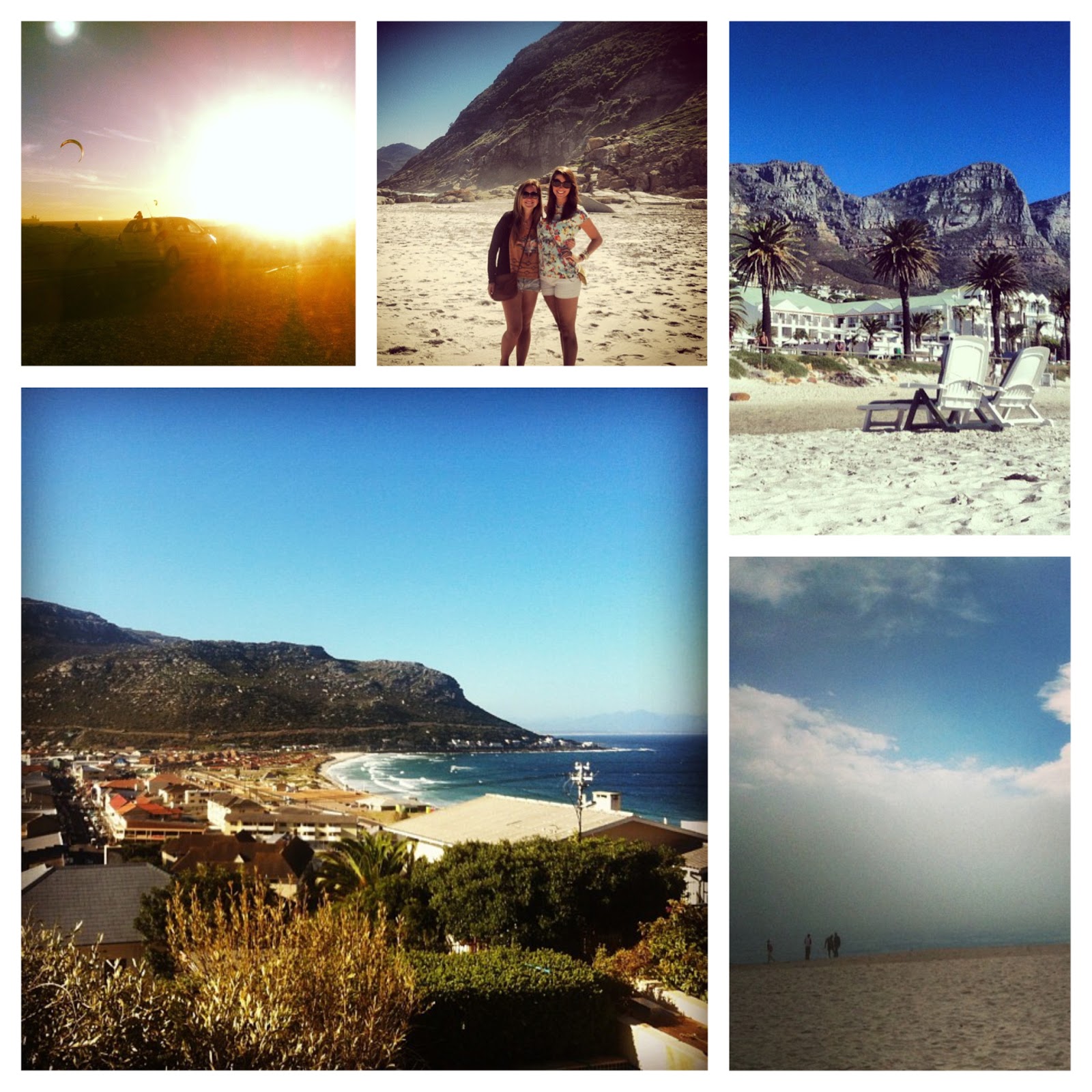
It's "Five Sense Friday" time, and this week's perspective on life in Cape Town is sight. If you're following my journey from afar via Facebook or Instagram, you've seen a good chunk of my favorite sites in Cape Town. If not, I've included my favorite photos in miniature collages below. 

When I remember Cape Town, I'll remember
its views of the ocean and its beaches.

When I remember Cape Town, I'll remember
the stunning University of Cape Town campus.

When I remember Cape Town, I'll remember
the corners of the city that became my home.

When I remember Cape Town, I'll remember
the faces of the people with whom I shared my experience.

When I remember Cape Town, I'll remember
how beautiful it was.

When I remember Cape Town, I'll remember
the smiles of my students at Scalabrini refugee centre.

When I remember Cape Town, I'll remember
the vibrant sights of our neighborhood.

When I remember Cape Town, I'll remember the ocean outstretched as far as I can see. I'll remember finding my house through binoculars at the top of Table Mountain. I'll remember the view of the street from my room, the view of the mountain from our terrace, and the view of our neighborhood from my favorite coffee shop. I'll remember watching taxis roll down Long Street. I'll remember the relaxed, bohemian style. I'll remember watching rain blow sideways. I'll remember the rainbow arching into Table Mountain when the rain turned to sun again.

I'll remember the dutch architecture, and I'll remember what seemed like millions of penguins at Boulder Beach. I'll remember the neon yellow bibs the car guards wore. I'll remember the Volkswagen logo that branded so many cars. I'll remember the familiar faces of Kloof Street. I'll remember the advertising. I'll remember the red city sightseeing buses, the blue Jammie Shuttle buses, and the MyCity buses. I'll remember Lion's Head, Signal Hill, and Table Mountain, all visible from our front door.

I'll remember the way it looked in real life, because pictures just don't do it justice.


Friday, June 21, 2013

I'll Remember The Way It Sounded

As promised, here's the first of my "Five Sense Friday" posts. With hopes of truly immersing myself in my surroundings while I'm, well, still in them, I've taken on this challenge. I must add a disclaimer, though. You won't really understand unless you hear/see/smell/touch/taste Cape Town yourself.

When I remember Cape Town, I'll remember the way it sounded.

I'll remember the sound of relentless construction just outside my window and the incessant echo of jackhammering and shoveling that, unfortunately, comes with it. I'll remember reading in bed, only to be interrupted by the sound of a taser being pressed into a man's skin by a policeman over and over and over again. I'll remember the I-think-I-can chugging of truck engines as they drag their heavy cargo up the steep incline of the hill.

I'll remember the clicks of the Xhosa language sprinkled throughout the sidewalks, and I'll remember the way the shop assistant rambled in Afrikaans while I mailed my postcards to the other side of the world. I'll remember the impressive English pronunciation showcased by Zimbabweans driving taxis. I'll remember my students' greetings - "Good morning, teacher!" - and their farewells - "Good bye, teacher. Thank you for teaching English. See you next time." I'll remember the sound of the rioting just outside the classroom window.

I'll remember the almost incomprehensible array of South African accents on the other side a phone call. I'll remember the sound of Goldfish, a South African electronic/dance group, squeezing through the speakers in our house, our favorite hangouts, and car radios. I'll remember hearing the exuberant cheers of soccer and rugby fans at Rafiki's... from my bed. I'll remember the shrill ding! ding! of WhatsApp's notifications. I'll remember the series of honking the minibus taxi drivers used to make sure everyone knew they were there. I'll remember listening to the same announcements made in four languages, just to make sure everyone in the township got the memo.

I'll remember the way the refrigerator obnoxiously beeped if you left it open too long. I'll remember the creak of the spiral staircase that led up to my room, and probably the inevitable crash of said staircase, if I had to guess. I'll remember the sound of our landlady's children playing on the terrace because she shared our property. I'll remember overhearing Skype conversations with the whole wide world: Russia, Australia, Philadelphia, New Zealand, Germany, etc. I'll remember the sound of the wind crashing into our walks and shaking our house. I'll remember the sound of the waves crashing on the many shores. I'll remember the sound of the school bell ringing in our neighborhood. I'll remember the solemn warnings: "Winter is coming."

I'll remember the strangers' pleas: "Lady, spare some change for us? For milk and bread?" I'll remember the way my students let phrases like "bungee jump" and "scuba diving" roll off their tongues like verbal toys. I'll remember the sounds of my own mispronunciations of Afrikaans words integrated into everyday conversation: Tamboerskloof, boerewors, vetkoek, koeksisters, naartjie, and mielie, to name a few. I'll remember the brazen accents of American tourists and students abroad, who seemingly shouted every word they said to all corners of Africa. I'll remember the familiarity of my dad's small town Kentucky accent fumbling through my computer speakers.

How could I ever forget the way Cape Town sounded?


Thursday, June 20, 2013

Both Happy and Sad

Any writer would agree, I think, that sometimes it's incredibly difficult to find the right words for a feeling or emotion that cannot simply be labeled with one word like "happy," "hopeful," or "envious." Sometimes, another person's words do the best job, even if the words are transposed to a different context.

Searching for the words to delineate the nostalgic feelings of making a new home while missing another one has been a long quest of mine. While watching one of my favorite films last night, I stumbled across familiar words that came closer than I have yet.

"I want you to know that I am both happy and sad, and I'm still trying to figure out how that could be." - Charlie, in The Perks of Being a Wallflower (Stephen Chbosky)

I first read Stephen Chbosky's The Perks of Being a Wallflower in high school. I didn't just read it, though. I devoured it, underlining and annotating and "dog-earing" pages that were too good to read only once. I loaned my copy to a friend who would appreciate it like I did, and I welcomed his reaction scribbled on pages and pages of notebook paper exchanged in the library. I reveled in the stranger's words that captured so many of my feelings and perspectives. Quotes from the book continued to decorate my scribblings and notebook decorations throughout the years.

I revisited The Perks of Being a Wallflower on my journey to South Africa. Again, I fell in love with its poignant words and relevance, even after all of these years. It felt like a reunion with Charlie, Patrick, and Sam, who seemed like familiar friends after all of this time. Thanks to a generous friend who shared a digital copy of the film with me, I've watched it over and over since being here.

Book cover (left) and movie poster (right)


While the context may be a bit different, the notion of being "both happy and sad" is the best way I've found to explain one of the more complex emotions I've encountered in my years. When I am traveling, whether across the country or across the world, I repeatedly face this feeling. Of being happy to explore a new place, yet sad to miss the people and places I've left behind.

It's most poignant when something ignites a fond memory from the past. For example, when I'm having my morning coffee and the barista grinds another round of espresso beans, I'm transported to my favorite Starbucks in the whole wide world, the people I've met there, and the memories I've made with them. It also surfaces when I try a new food or drink, thinking I'll experience some uncharted territory of taste, only to stumble into a familiar flavor of home or days long gone.

The trickiest emotion, though, is a reverse experience: feeling happy in the fleeting moment, only to remember that I'll most likely be a bit sad about the very same thing someday. Because soon I'll leave this thing (or person, or place, or feeling) for another home, maybe even an old home, and I'll miss this one as much as all of the other ones. That's the hardest thing for me to capture: the teetering between two ends of the spectrum while your heart tries to find the elusive balance.

And, if you ask me, that sweet spot right in the middle is what Chbosky was writing about when he wrote, "And in that moment, I swear we were infinite." Those rare moments when my feelings aren't in conflict. Instead, they're perfectly coexisting. Just for a moment. Just at the bottom of the pendulum's swing. I've written about those moments before. The ones when I feel like you're in the right place at the right time with the right people. Like in a conversation with a refugee, whose English words came from you. Or the stunning clarity of the mountains in the distance on a morning walk. Or dancing to Goldfish's "Get Busy Living" in front of a spectacular sunset with new friends from a different part of the world.

That tricky emotion - "both happy and sad" - is why I love to adventure, I think. It's why I feel unsettled and claustrophobic when things become complacent and routine. It's a craving for the pendulum swing between happy and sad, for missing something else. It's a yearning for that middle moment of peace and serenity bookended by chaos.

Sometimes I think you can't appreciate where you are, who you're with, and how you feel unless you understand that it is fleeting and fading. Unless you truly understand that you'll miss it from a different perspective. And that the wheel goes on, ultimately leaving you feeling "both happy and sad" when something sparks a memory in the future.

In an effort to fully immerse myself into my experience here, I'm kicking off a series of posts, which I'm referring to as "Five Sense Fridays." For the next few Fridays, I'll choose a sense (sight, hearing, taste, touch, smell) and try to capture some of those things I'm bound to miss about my everyday life in Cape Town. A fun challenge anyone can do... anywhere! Feel free to join.

Friday, June 7, 2013

Most Beautiful (Ride to) Campus in the World

To get to campus, I take the Jammie Shuttle, a campus shuttle system with various stops around Cape Town. My shuttle ride is approximately 15-20 minutes long depending on traffic, and it boasts some of the most beautiful views of this sprawling city.

For a new perspective of my everyday life in Cape Town, check out the videos below. I recorded the first one on my way to campus yesterday, and I recorded the second on my way back to the city centre, which most refer to as town. Enjoy the stunning views from the side of a mountain, and pardon the student conversations in the background. 


Is there a more beautiful campus commute out there in the world? I'd argue that the University of Cape Town steals the show for that competition. 

Monday, June 3, 2013

Welcoming Winter

Forget everything you thought you knew about the weather in South Africa.

If you thought you knew anything about it in the first place, that is. While most of the photos I've taken during my stay in Cape Town have been riddled with sunshine, sand, and palm trees, the weather has taken an abrupt turn... for winter.

A damp, rainy Monday in Cape Town. Typical winter day.

Since I arrived in warm and sunny January, people have said ominous things like "just wait until winter" and "winter is coming" with a dreadful tone. Others have assured me that it's really not so bad, especially compared to the winter weather one experiences in the USA.

Yesterday, however, lived up to all of those horrifying tales of Cape Town's winter. I spent the day at the V&A Waterfront, which is a nice mall in town. While most trips to the mall end in shopping bags of new outfits, this one was a bit unconventional. I was on a mission for a few things, but at the top of the list was my winter readiness: a heated blanket and a winter coat.

Seems ridiculous, doesn't it, to think that I'd need a heater in Cape Town, South Africa? While the actual temperature doesn't drop terribly low, the weather conditions and the buildings make winter hard to handle. When rain and wind join forces, you're left soggy and damp. And when your house isn't insulated and your windows are single paned, you find little refuge indoors.

So, off to the mall to prepare for the winter that had already seeped into our bones. As if the damp and chilly day hadn't already propelled my purchasing enough, the skies decided to applaud... with hail.

A picture Kelly's sister sent. No big deal.
Photos of the hail posted at
https://www.facebook.com/passionateaboutcapetown

Yes, hail. Lots of hail. It sounded like the building was going to collapse, and the people in the mall were acting like school children do on their first snow day of the year, buzzing with jubilant awe. One customer's children were exclaiming that they held the hail, and that it was "sooooo cold!" Then my phone buzzed with an automated email from Gap about the summer styles and sales.

I couldn't help but smile. Because this experience was exceptional. Because snow doesn't happen here, but hail does. Because I was buying an electric blanket and a winter coat in June.

And, I must admit, I bought a space heater today, too. As soon as I find a new umbrella (since the wind blew my last one inside out), I'll be all set for a blustery and wet winter in Cape Town. Now, snuggled up in my newly toasty bed with a hot cup of rooibos tea, it doesn't seem so miserable.

Cape Town, you're full of surprises.


Check out this video for a taste of a South African accent... and a hail-covered beachfront.

Thursday, May 30, 2013

Cape Town: By the Numbers

It's no secret that I am a language person. I am passionate about the power of a well-constructed sentence, and I thrive on the feeling of finding the perfect word(s) to describe something intangible. Travel provides endless opportunities to explore words... in crafting descriptive messages sent home, in deciphering location-specific phrases and slang words, in discussing tough concepts with people of a different perspective.

There's another side of traveling that doesn't come so naturally for me. No matter where in the world I find myself, I'm inevitably left with a period of time hallmarked by the overwhelming feeling of numbers and conversion formulas swimming around my mind. With that being said, I thought I'd take a different approach for this update. My adjustment to Cape Town... by the numbers.

Dear USA (and I really do mean dear),
Why must you make it so complicated?
Yours truly, International Travelers
One of the most obvious adjustments to a new country is the currency. The unit of currency here is the South African Rand (ZAR). Like most foreign currency, it's much more brilliantly designed, boasting illustrations of the "Big 5" animals of South Africa and, on the recently issued editions, Nelson Mandela's portrait. As I write this, the exchange rate sits at 9.78 ZAR per 1 United States Dollar, meaning that my R17 coffee costs $1.74 and my R30 taxi ride from Long Street costs $3.07. This is especially overwhelming when you're trying to budget according to a spendable amount of US dollars, but all of your expenses are in rand.

Currency: South African Rand

Checking the weather forecast is still incredibly puzzling to me. When you've grown up with the Fahrenheit system of temperature, it's really hard to decipher the appropriate attire for 17 degrees Celcius. I, of course, learned the conversion for Celcius to Fahrenheit at various points of my education, but that doesn't mean I can calculate the conversion quickly. I usually end up typing it into my Google search bar to find that 17 degrees Celcius is (a more understandable) 62.6 degrees Fahrenheit. As my friend Michael Mizrahi (@miz) tweeted not too long ago, "Wanted: a weather app called 'Yesterday' that tells me if the weather will be warmer or colder than yesterday. That's all I need."

Weather forecast... in Celcius.
Let's not forget the whirlwind of confusion that ensues when an American, raised on the customary (imperial) units of the USA, gets dropped into a world of metric measurements. Speed limit signs, recipes, and nutrition labels all become a blur. What does it mean if koeksisters have 1879 kJ of "energy" per 100 g? Oh, right... 447 CALORIES. How fast is 120 km per hour? Of course... 74.5 mi per hour. And how much of a 750 ml bottle of vinegar should I use for 2 cups? Let me set up a casual algebra problem. Aha... two-thirds of it.

Nutritional information for koeksisters,
a super sweet South African treat

A South African speed limit sign

Needless to say, it's easy to become overwhelmed by the conversions. I often find myself laughing, though, because it's almost as all my math and science teachers of the past are mocking me. Those unrealistic word problems that force you to construct and sort out an equation to solve for x? Not so unrealistic anymore. All those teachers needed to do was wag a finger in my face and say, "You'll need this when you travel abroad someday!"

Thursday, May 23, 2013

Teaching the Teacher


About two weeks ago, I agreed to add an Elementary II level class to my schedule. Another teacher was unable to finish the term, and I thought Why not? and accepted the challenge. Little did I know, that agreement lined me up for what must become one of the most memorable lessons I’ve ever taught anyone anywhere. And that's a bold statement.

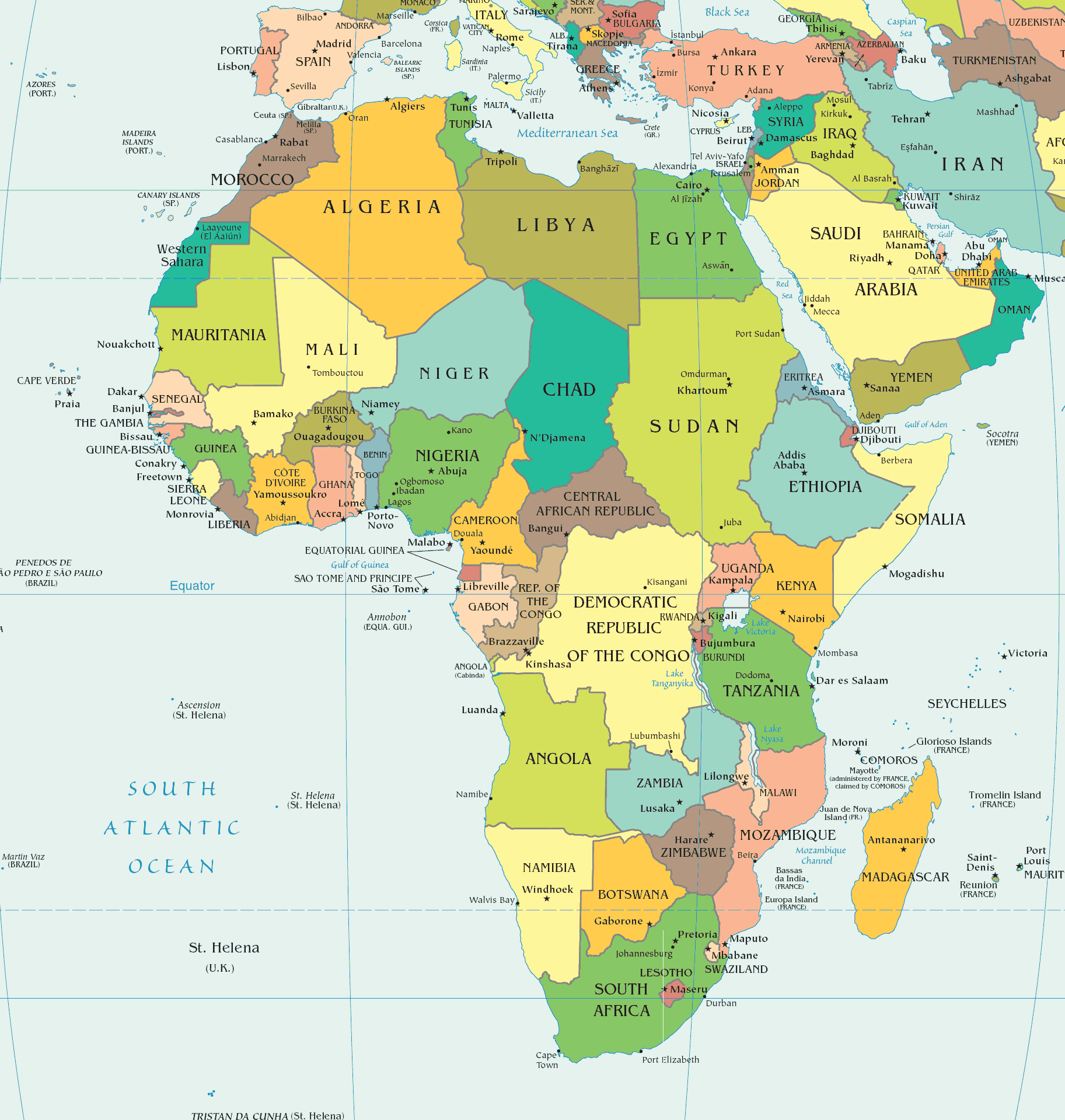
As I’ve mentioned before, I teach English at a local refugee center that serves people who have come to Cape Town from Sub-Saharan countries such as the Democratic Republic of the Congo, Malawi, the Republic of the Congo, Somalia, Rwanda, the Central African Republic, and Burundi. We follow the English for Life curriculum, meaning most of the lessons are already outlined and ready to be taught.


Source: http://www.ilike2learn.com/ilike2learn/
Continent%20Maps/Africa%20Political%20Large.gif

I was welcomed to the refugee center for Monday’s lesson by a protest occurring just outside the door, which left the atmosphere rather hectic. The very determined group of protestors was singing and chanting, which poured into the open windows of our classroom. I knew this would affect our lesson, but I was ready for the challenge.

The day’s lesson encompassed “everyday jobs” like sweeping the floor, taking out the garbage, cooking dinner, and making the beds. Through exercises such as “read and repeat,” “write and share,” and general question-and-answer conversation, the students practice reading, speaking, and writing English. I never expected the lesson to turn around and teach me. However, it certainly did. It didn’t take long for gender roles and gender equity to come into play.

Teacher’s question: “When do you do the dishes?”
Student’s statement: “I don't. That’s a woman’s job.”

I should have seen this one coming, as I knew most African cultures were rather rigidly male-dominant and sensitive to gender roles. After a few exchanges such as this one, I decided to take a different approach. I started posing scenarios that involved “my husband” in order to take the personal element away. After a few of these scenarios, a female student in the back of the room interjected.

Teacher’s statement: “My husband cooks dinner, and I do the dishes.”
Teacher’s question: “Who cooks dinner?”
Student’s statement: “Teacher, you always say husband. Why can’t you say wife?”

Well, my friend, that’s a great point. I most certainly could.

Welcome to the classroom, sexual orientation issues. From here, all sorts of students began chiming in with their own opinions of sexual orientation – a few in English, and many in French, which I couldn’t understand and, therefore, couldn't monitor. I reclaimed the students’ attention with a rather loud declaration: “Everyone's family, everyone's life, everyone's house is different. And that is okay, right?"

Thankfully, my statement was greeted with amiable head nodding and general agreement, with only a few outliers. With a sigh of relief, another high-tension moment settled. We carried on with the lesson under this notion, but one more disruption was in store.

Somewhere in the distance outside, there was an unidentified explosion sound. It was most likely something construction-related, or perhaps a car crash of some sort, so I kept teaching. It was quickly apparent from the far off look in a few students’ eyes, though, that their minds wandered elsewhere: war.

Because most of my students are from war torn parts of Africa, it isn’t unusual for war to be a part of everyday conversation. I’ve run into statements like “I live with my daughter, but my husband is in the DRC because of the war” before. However, the students’ reaction to the explosion sound caught me off guard. With a few whispers that soon escalated, the students exchanged recognition of the sound. “Is it war?” one student asked me, before a French conversation spread like wildfire throughout the classroom.
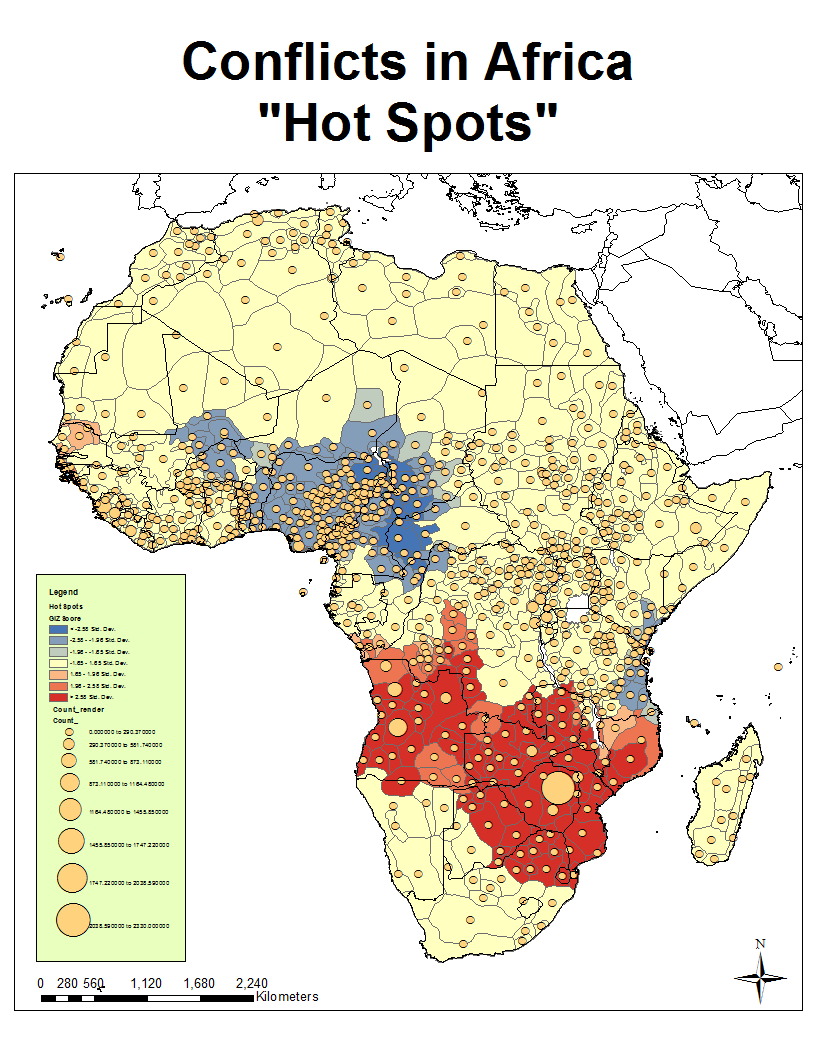
Source: http://pslarson2.files.wordpress.com/
2011/01/hotspots.png?w=894

In this image, the circles represent conflict events.
As you can see, many of the countries my students
call home are highly affected by conflict.

Forget the everyday jobs. Monday’s lesson was one intended for me. It was a lesson in context, in culture, and in perspective. When reviewing the lesson for the day, I should have anticipated some of the sensitivities I encountered, knowing the cultural context of my students. I also got to apply classroom management to a high stress atmosphere, which is certainly a good skill to "rehearse" from time to time.

And when the explosion sounded in the distance, I learned a valuable lesson in perspective. I counted my blessings. For me, war happens on TV, in the news, and in history books. For my students, war happens in the not-so-distant memories of your home. I won't soon forget the look on the face of the student who so meagerly asked, "Is it war?"

South Africa, as many locals will tell you, isn't "real" Africa. And while there may be a distinction between the rest of Sub-Saharan Africa and this little corner of the world, working at the refugee center has given me a unique opportunity to learn about other parts of Africa from those who just recently uprooted their lives to pursue opportunity and possibility. For them, English class is a gateway, and I have to agree. It's reciprocal; English class is certainly a gateway for me, too.